
How could digital currencies, asset tokenisation and distributed ledger technology change the way traditional financial transactions take place? A recent initiative by Singapore’s central bank provides a real-world example.
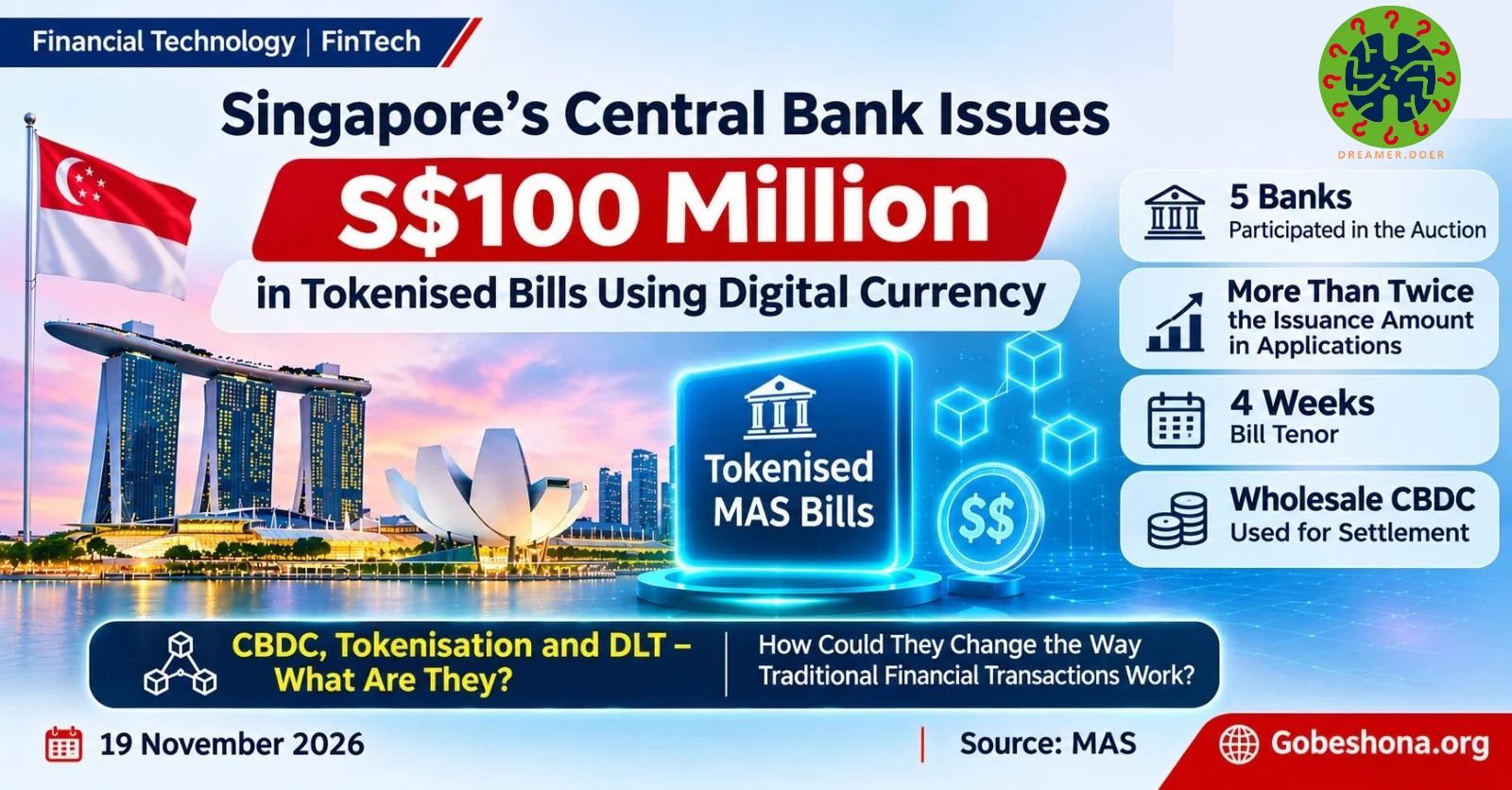
On 19 November 2026, Singapore’s central bank, the Monetary Authority of Singapore (MAS), announced that it had successfully issued S$100 million worth of tokenised MAS Bills.
These four-week bills were issued on 6 November. Central Bank Digital Currency (CBDC) was used to complete the financial transactions.
Five major banks in Singapore participated in this initiative. Although MAS issued S$100 million worth of bills, the banks submitted applications to purchase bills worth more than S$200 million.
But what are MAS Bills? What does tokenisation mean? How does central bank digital currency work? And how is this initiative different from the traditional financial system?
To understand these matters, we first need to learn about some basic concepts of the financial system.
What Is the Monetary Authority of Singapore (MAS)?
The Monetary Authority of Singapore is Singapore’s central bank. Established in 1971, this institution plays an important role in managing and regulating the country’s financial system.
MAS performs many functions similar to those performed by Bangladesh Bank in Bangladesh and the Reserve Bank of New Zealand in New Zealand.
Its main responsibilities include managing Singapore’s monetary policy, issuing currency, supervising banks and other financial institutions, and maintaining financial stability.
In addition, MAS works on introducing new technologies into the financial sector. Its recent initiative involving digital currency and asset tokenisation is part of these efforts.
What Are MAS Bills?
MAS Bills are short-term debt securities issued by Singapore’s central bank.
Central banks use different financial methods to control the amount of money available in the banking system. Issuing MAS Bills is one of these methods.
Suppose a commercial bank has some extra money. The bank can use a portion of that money to purchase bills issued by the central bank.
For example, suppose a bank purchases a four-week MAS Bill for S$998,000, which will have a value of S$1 million at the end of its maturity period.
After four weeks, the central bank will pay S$1 million to the bank. As a result, the bank will earn S$2,000.
In this case, the central bank is receiving money from a commercial bank for a specific period. This reduces the amount of money immediately available for use in the banking system.
The above calculation is provided only to explain the concept. It does not represent the actual price or return of the recently issued MAS Bills.
What Is Liquidity?
Liquidity is an important concept in the financial system. In simple terms, liquidity is related to how much money a person or institution has available for immediate use, or how easily an asset can be converted into cash.
Suppose a bank has assets worth BDT 100 million. However, most of these assets have been provided as long-term loans to different individuals and businesses.
Although the bank owns a large amount of assets, it may not have enough cash to immediately return money to its customers. This can be described as a liquidity problem.
On the other hand, a bank may also have more money available than it currently needs.
Central banks use different financial methods to manage liquidity in the banking system. Issuing MAS Bills is one such method.
What Is Tokenisation?
Tokenisation is a method of representing an asset, ownership of an asset, or a financial right through a digital token.
Let us understand this through an example.
Suppose a financial institution issues a debt security worth BDT 1 million. In the traditional system, information about who owns this debt security, when it was purchased and to whom it was later sold may be stored in the computer systems of different financial institutions.
Through tokenisation, the ownership of this debt security or the financial rights associated with it can be represented by a digital token. Information about the ownership and transactions of that token is recorded on a distributed ledger.
This token is not simply a digital image or a piece of information. Under the relevant financial and legal arrangements, it represents ownership of an asset or a financial right.
Government debt securities, company shares, investment funds, bank deposits and even ownership interests in real estate can be tokenised.
The tokenised MAS Bills issued by Singapore’s central bank are also short-term debt securities. However, a different technology has been used to issue them and record their ownership and transaction information.
What Is Distributed Ledger Technology (DLT)?
A ledger generally refers to a system used to record financial transactions.
In the past, these records were maintained in paper-based accounting books. Today, most financial institutions use computers to maintain these records.
In the traditional financial system, different banks and financial institutions store transaction information in their own separate databases.
Suppose one bank purchases a debt security worth BDT 1 million from another bank. Information about this transaction may be stored in the separate databases of the purchasing bank, the selling bank and other institutions involved in the transaction.
Later, these institutions need to check whether there are any differences between their records.
Distributed Ledger Technology (DLT) is a technology that allows multiple participants to record and verify transaction information through a shared record-keeping system.
Participants can view information and add new transactions according to specific rules and permissions.
Blockchain is one type of distributed ledger technology. However, not every distributed ledger is a blockchain.
Singapore’s central bank used its own distributed ledger infrastructure to issue the recent MAS Bills.
What Is Native Tokenised Issuance?
There are two important methods of bringing financial assets into a tokenised system.
Traditional Issuance Followed by Tokenisation
In this method, a debt security is first issued through the traditional financial system. A digital token is then created to represent that debt security.
In this case, the connection between the original debt security and the digital token must be maintained. It is also necessary to ensure that there are no differences between the ownership records of the original debt security and the information recorded in the digital token.
Additional technological systems and intermediary institutions may be required to perform these tasks.
Native Tokenised Issuance
In this method, the debt security is issued as a digital token from the beginning. There is no need to issue a separate debt security through the traditional system and then convert it into a token.
This method is known as native issuance.
Singapore’s central bank used the second method. The S$100 million worth of MAS Bills were issued and recorded directly on a distributed ledger.
According to MAS, this approach removes the need for reconciliation and intermediaries associated with issuing debt securities through traditional methods and then tokenising them.
What Is Central Bank Digital Currency (CBDC)?
Central Bank Digital Currency (CBDC) is a digital form of money issued by a country’s central bank.
Today, we already make digital financial transactions using mobile banking, internet banking and bank cards. So, how is central bank digital currency different from these existing methods?
The money in our commercial bank accounts represents a financial claim against that bank. In other words, the bank has an obligation to pay us that amount of money.
On the other hand, central bank digital currency is considered a direct liability of the central bank.
Like paper banknotes, it is money issued by the central bank. However, it exists in digital form.
There is also an important difference between CBDCs and cryptocurrencies such as Bitcoin. Bitcoin is not issued by any central bank. However, a CBDC is issued by a country’s central bank, and its value is expressed in that country’s official currency.
What Is the Difference Between Retail and Wholesale CBDC?
Based on their intended use, central bank digital currencies can mainly be divided into two categories.
Retail CBDC
Central bank digital currency designed for everyday financial transactions by individuals and businesses is known as retail CBDC.
It could be used for activities such as purchasing products from shops, paying electricity bills or transferring money from one person to another.
Wholesale CBDC
Central bank digital currency designed to complete transactions between banks and authorised financial institutions is known as wholesale CBDC.
It can be used for large-value money transfers between banks, purchasing and selling debt securities, and completing other financial transactions.
Singapore’s central bank used wholesale CBDC to complete the recent MAS Bills transactions.
In other words, this initiative does not mean that a new digital currency has been introduced for the everyday use of the general public. It is mainly related to transactions between banks and financial institutions.
What Is Financial Settlement?
In financial markets, agreeing to purchase or sell an asset and finally completing that transaction are two different things.
Suppose Bank A decides to purchase a debt security worth BDT 1 million from Bank B.
The two banks have agreed on the price and other conditions. However, the money and ownership of the debt security have not yet been transferred.
When Bank A makes the payment and Bank B transfers ownership of the debt security, both parties complete their financial obligations.
This process is known as settlement.
In Singapore’s recent initiative, the financial assets being purchased and sold were tokenised MAS Bills. The payment method was wholesale CBDC.
As a result, both the financial assets and the payment method were managed through digital infrastructure.
What Is Delivery versus Payment (DvP)?
An important risk in financial transactions is that one party may complete its obligation while the other party fails to complete its obligation.
Suppose a bank is purchasing a debt security worth BDT 1 million. The bank makes the payment, but for some reason, ownership of the debt security is not transferred to it.
To reduce this type of risk, financial markets use a method known as Delivery versus Payment (DvP).
Under this method, the financial asset is delivered only if the corresponding payment takes place. Similarly, payment takes place only if the financial asset is delivered.
Using tokenised financial assets and central bank digital currency creates opportunities to make this process more automated.
However, the published media release does not provide detailed information about the specific DvP technology used in the recent MAS Bills issuance.
What Is Reconciliation?
In the traditional financial system, different institutions involved in a transaction record transaction information in their own computer systems.
Suppose the records of one bank show that it purchased 100 debt securities from another bank. However, for some reason, the selling bank’s records show that it sold only 99 debt securities.
This difference must be identified, and the correct information must be determined.
The process of checking whether financial information held by different institutions matches is known as reconciliation.
This process requires time, human resources and technological infrastructure.
When a shared distributed ledger is used, participating institutions can obtain information about the same transaction from a shared record-keeping system. This can reduce the possibility of differences between separate records.
However, this does not mean that all types of reconciliation or the need for intermediary institutions will completely disappear from the financial system.
What Is the Singapore Dollar Test Network?
The Singapore Dollar Test Network is a shared digital ledger infrastructure operated by Singapore’s central bank.
Through this infrastructure, authorised financial institutions can test methods of settling transactions involving tokenised financial assets using wholesale CBDC.
On one side, there are tokenised financial assets. On the other side, there is central bank digital currency used to purchase those assets.
The Singapore Dollar Test Network creates an opportunity to manage both of these components through shared digital infrastructure.
MAS has announced that the network will be renamed SG Digital Ledger.
Which Banks Participated in This Initiative?
Five Primary Dealer banks participated in the recent MAS Bills auction.
These banks are:
- DBS Bank
- HSBC Singapore Branch
- Oversea-Chinese Banking Corporation (OCBC)
- Standard Chartered Bank Singapore
- United Overseas Bank (UOB)
Primary Dealers are financial institutions authorised by a central bank or another relevant authority to perform specific responsibilities related to purchasing and selling debt securities issued by governments and central banks.
These institutions also play an important role in keeping the debt securities market active.
What Does It Mean When Auction Applications Exceed Twice the Issuance Amount?
Singapore’s central bank issued MAS Bills worth a total of S$100 million. However, the participating banks collectively submitted applications to purchase bills worth more than S$200 million.
In financial markets, when applications to purchase a debt security exceed the available supply, the issuance is described as oversubscribed.
A measure known as the bid-to-cover ratio is used to measure this demand.
This ratio is calculated by dividing the total value of applications by the total value of debt securities issued.
For example, if applications worth S$250 million are received for debt securities worth S$100 million, the bid-to-cover ratio will be 2.5.
In the case of the recent MAS Bills, this ratio was greater than 2.
This indicates that there was considerable demand among banks for this particular debt securities auction. However, the results of a single auction cannot be used to draw conclusions about market demand for all types of tokenised financial assets.
What Is Interbank Lending?
Commercial banks sometimes borrow money from other banks to meet their financial requirements.
Suppose a bank needs an additional BDT 100 million to complete its financial transactions today. Another bank has this amount of extra money available.
The first bank can borrow money from the second bank for a short period.
This arrangement, in which one bank lends money to another bank, is known as interbank lending.
When the loan generally lasts until the next business day, it is known as interbank overnight lending.
In 2025, Singapore’s central bank successfully completed a live interbank lending transaction using wholesale CBDC.
The recent issuance of MAS Bills takes that initiative a step further.
In the earlier initiative, digital currency was used to complete lending transactions between banks. This time, a tokenised version of a familiar and trusted financial asset has been added to that digital infrastructure.
What Is Secured Lending?
When individuals or institutions borrow money, they may provide an asset as security to give the lender some protection.
Suppose a person provides their land or house as security when borrowing money from a bank.
If the person fails to repay the loan, the bank may take steps to recover the loan amount using that asset, according to the agreement and relevant laws.
This type of lending is known as secured lending. The asset provided as security for the loan is known as collateral.
Similar lending transactions also take place between banks. In such cases, financial assets such as government debt securities or bills issued by central banks can be used as collateral.
This initiative by Singapore’s central bank is creating a path towards a system in which a bank could use its tokenised MAS Bills as collateral to borrow wholesale CBDC from another bank in the future.
What Is Collateral Management?
The responsibilities of a financial institution do not end after accepting an asset as collateral for a loan.
The institution needs to regularly monitor several matters, including the current value of the collateral, whether its value is sufficient compared with the loan amount, who owns the asset and how the collateral will be returned after the loan is repaid.
This entire process is known as collateral management.
Using tokenised financial assets could create opportunities to make activities such as verifying ownership, transferring and monitoring collateral faster and more automated.
Singapore’s central bank plans to expand the use of tokenised MAS Bills in collateral management during the next phase of its initiative.
Singapore’s Recent Initiative at a Glance
| Topic | Details |
|---|---|
| Issuing institution | Singapore’s central bank (MAS) |
| Total issuance amount | S$100 million |
| Issuance date | 6 November 2026 |
| Announcement date | 19 November 2026 |
| Duration of the debt securities | Four weeks |
| Maturity date | 4 December 2026 |
| Issuance method | Native tokenised issuance |
| Infrastructure used | Singapore Dollar Test Network |
| Payment method | Wholesale CBDC |
| Participating banks | Five |
| Total auction applications | More than S$200 million |
| Next live trials | 2027 |
Why Is This Initiative Important for Financial Technology?
Issuing debt securities by central banks is not a new activity. Central banks around the world have been carrying out such financial activities for many years.
Even the use of computers and digital technology in financial transactions is not new.
What makes Singapore’s initiative different is that a traditional financial asset was issued as a digital token from the beginning, and central bank digital currency was used to complete transactions involving that asset.
In other words, this initiative did not simply convert a paper document into a digital format. Instead, a different type of technological infrastructure was used to issue financial assets, record their ownership and complete financial transactions.
Through this method, financial transactions may take less time to complete in the future. The amount of work required to reconcile records between different institutions could be reduced. At the same time, the process of using financial assets as collateral could become easier.
However, when using this technology on a larger scale, important matters will include its security, operating costs, legal acceptance and ability to work alongside traditional financial systems.
Although the recent initiative was successful, further trials will be needed to determine how much of these benefits can be achieved on a larger scale.
What Does Singapore’s Central Bank Plan to Do in the Future?
Singapore’s central bank plans to increase the amount of tokenised MAS Bills issued during the next phase.
At the same time, more financial institutions will be included in the system. There are also plans to expand the use of tokenised MAS Bills in collateral management.
MAS has invited interested financial institutions and organisations that operate financial market infrastructure to contact it regarding the next phase of live trials planned for 2027.
MAS Managing Director Chia Der Jiun stated that this live issuance allowed them to test a new method of issuing debt securities. At the same time, it provided an opportunity to further improve their own distributed ledger infrastructure.
As market acceptance increases, the institution will continue working to improve the usefulness and liquidity of tokenised MAS Bills.
According to him, tokenised MAS Bills could eventually play a complementary role alongside traditional MAS Bills.
Final Thoughts
When blockchain and digital assets are discussed, Bitcoin and other cryptocurrencies usually come to mind. However, the use of this technology is not limited to cryptocurrencies.
There are also opportunities to use distributed ledger technology in central banking, commercial banking, government debt securities, interbank lending and financial settlement systems.
Singapore’s recent initiative provides a real-world example of these possibilities.
This initiative is particularly important for students interested in Financial Technology (FinTech). Through a real financial transaction, it creates an opportunity to understand how central bank digital currency, asset tokenisation, distributed ledger technology and different financial market concepts can work together.
How much this technology will change the traditional financial system in the future will depend on the results of further trials and its acceptance among financial institutions.
References
- Monetary Authority of Singapore (MAS), 19 November 2026. MAS Announces Successful Issuance of Tokenised MAS Bills on the Singapore Dollar Test Network Using Wholesale Central Bank Digital Currency
- Monetary Authority of Singapore, 2025. MAS Announces Successful Live Trial of Settlement of Interbank Overnight Lending
- Monetary Authority of Singapore, 2024. MAS Announces Plans to Support Commercialisation of Asset Tokenisation
- Keynote Address by Mr Chia Der Jiun, Managing Director, Monetary Authority of Singapore, at the Singapore FinTech Festival 2026
Gobeshona | Gobeshona.org
Leave a Reply