
Published: September 2026
Source: OECD Programme for International Student Assessment (PISA) 2025
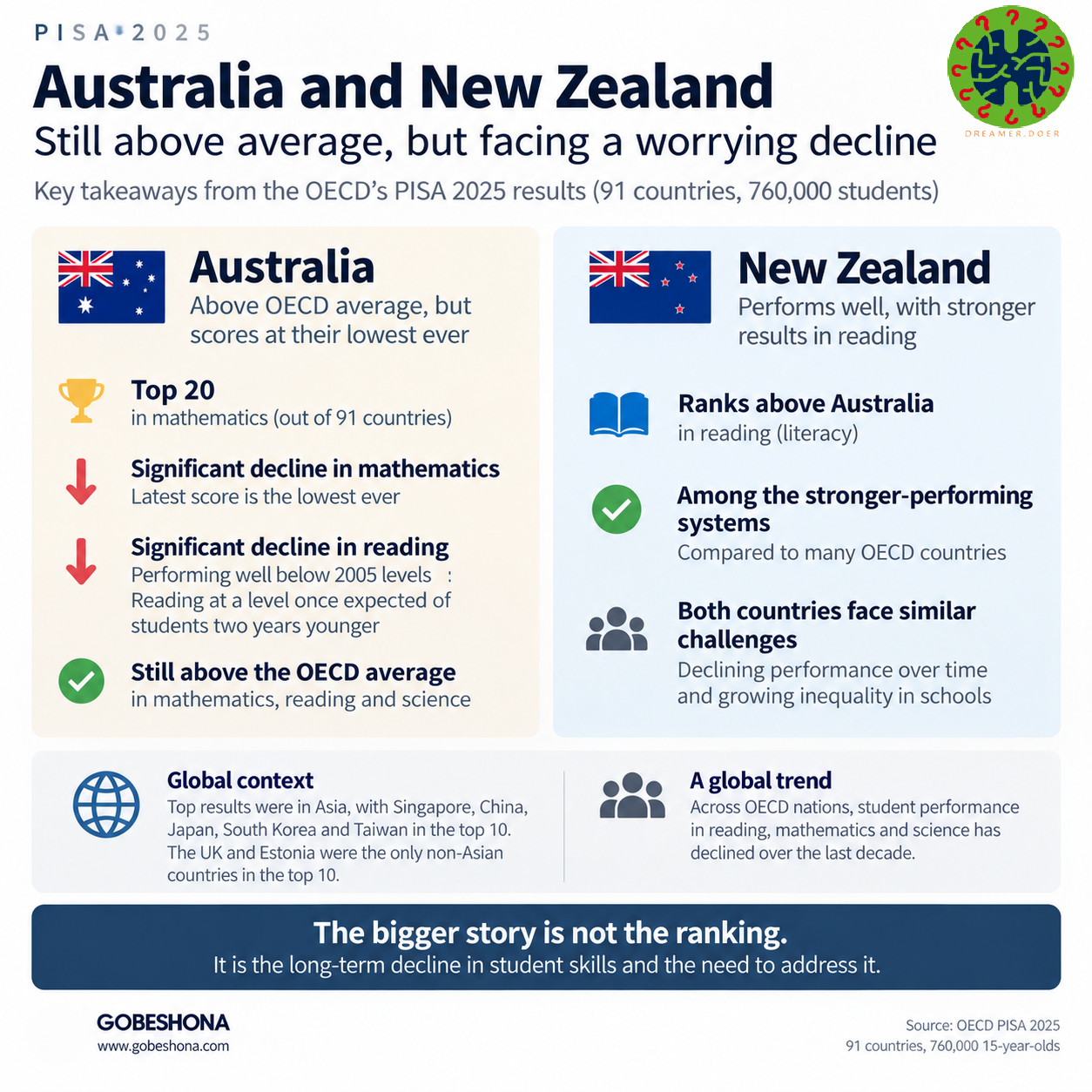
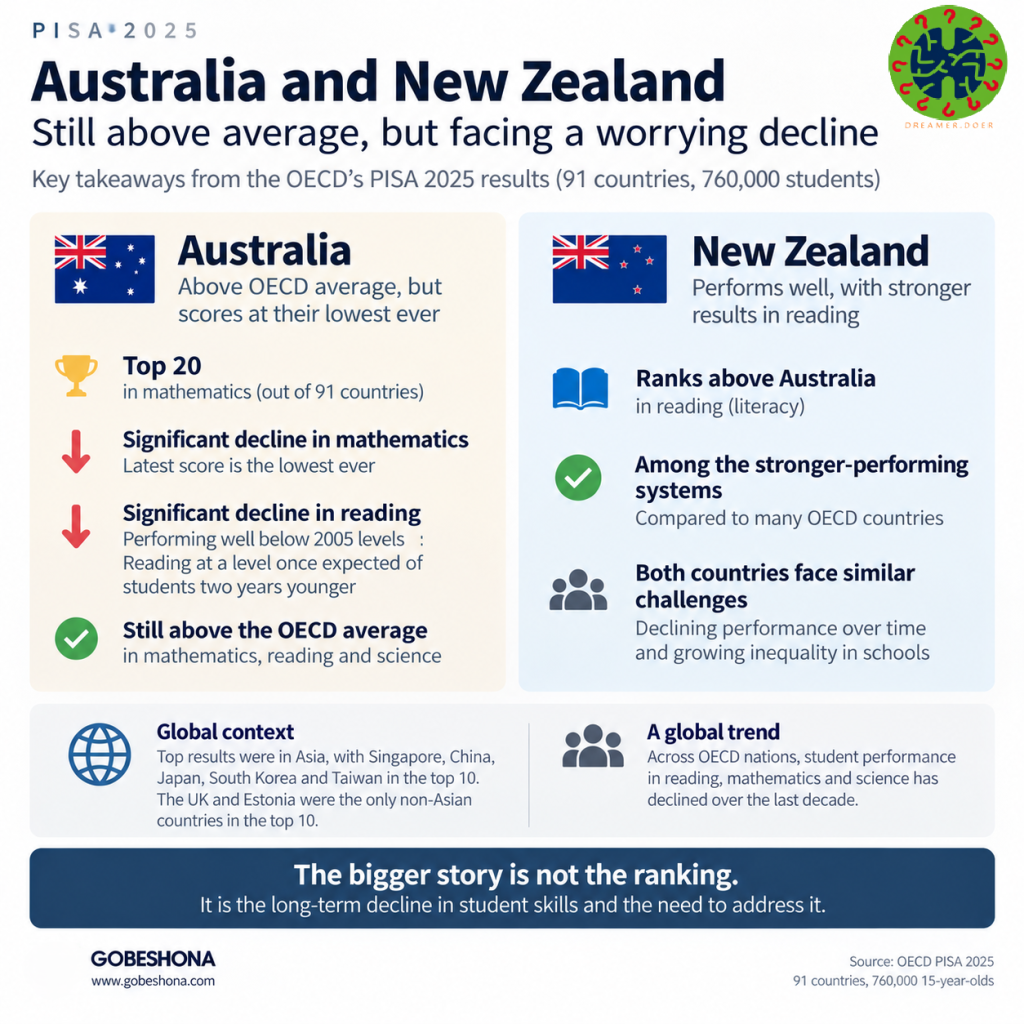
The latest results from the OECD’s Programme for International Student Assessment (PISA) present a mixed picture for Australia and New Zealand. Students in both countries continue to perform above the OECD average in mathematics, reading and science. Yet their relatively strong international positions sit alongside a more concerning long-term trend: performance in reading and mathematics has weakened over time.
The results therefore draw attention to an important distinction. A country can continue to perform comparatively well internationally while its students are performing less strongly than earlier generations of students in the same education system.
What is PISA 2025?
PISA is conducted by the Organisation for Economic Co-operation and Development (OECD) and assesses the knowledge and skills of 15-year-old students.
The 2025 assessment was the largest PISA study conducted to date. More than 760,000 students across 91 countries and economies participated, representing approximately 33 million 15-year-olds.
PISA 2025 focused primarily on science, while also assessing mathematics and reading. It additionally examined computational problem solving and collected information about students’ learning environments, attitudes, digital-device use and use of artificial intelligence for schoolwork.
The first volume of the PISA 2025 results was released on 8 September 2026.
A wider decline across OECD education systems
The challenges facing Australia and New Zealand are part of a broader international pattern.
Across OECD countries, average mathematics performance fell by approximately 22 PISA points between 2015 and 2025, while reading fell by approximately 28 points. Science also declined, although more modestly.
PISA 2025 consequently recorded the lowest OECD-average performance observed so far in mathematics and reading.
At the same time, the decline has not occurred everywhere. Several education systems continue to achieve very strong results. B-S-J-Z (China) and Singapore were the two highest-performing systems across science, mathematics and reading. Estonia, Japan, Korea, Macao (China), Chinese Taipei and the United Kingdom were also among the top-performing systems across the three subjects.
This suggests that declining performance is widespread, but it is not necessarily inevitable.
Australia: Above the OECD average, but mathematics and reading reach historic lows
Australia remains a relatively strong performer internationally.
Australian students scored above the OECD average in mathematics, reading and science in PISA 2025. Australian students were also more likely than the OECD average to reach minimum proficiency across all three subjects and more likely to be top performers in at least one subject.
However, Australia’s trend over time is considerably less positive.
According to the OECD, Australia’s 2025 results were lower than its 2022 results in mathematics and reading, while science remained broadly unchanged. More significantly, the OECD reports that the decline in mathematics and reading extends a downward trend that began much earlier.
The 2025 mathematics and reading results were the lowest ever measured for Australia in PISA.
The proportion of Australian students performing below Level 2, which PISA treats as an important baseline of proficiency, has also increased since 2015. The share of low-performing students rose by seven percentage points in mathematics and five percentage points in reading.
Despite this decline, Australia continues to outperform the OECD average.
In 2025:
71% of Australian students reached at least Level 2 in mathematics, compared with an OECD average of 65%.
77% reached at least Level 2 in reading, compared with an OECD average of 69%.
82% reached at least Level 2 in science, compared with an OECD average of 74%.
Australia therefore presents an important case where two statements can be true simultaneously: its students remain comparatively strong internationally, while national performance in key foundational areas has deteriorated over the longer term.
New Zealand: Strong international performance with similar long-term pressures
New Zealand shows a somewhat similar pattern.
Students in New Zealand also performed above the OECD average in mathematics, reading and science, as well as in computational problem solving.
Unlike Australia, New Zealand’s average results in mathematics, reading and science did not change significantly between 2022 and 2025. However, looking further back reveals a more concerning trend.
The OECD reports that New Zealand’s 2025 mathematics and reading results were below those recorded in both 2015 and 2018, continuing a decline that began earlier.
Compared with 2015, the proportion of New Zealand students performing below Level 2 increased by eight percentage points in mathematics and five percentage points in reading.
In 2025:
71% of New Zealand students reached Level 2 or above in mathematics.
77% reached Level 2 or above in reading.
81% reached Level 2 or above in science.
All three figures remain above their respective OECD averages.
New Zealand also has a comparatively large group of high-performing students. Around 14% reached Level 5 or above in reading, compared with only 6% across the OECD. In mathematics, 11% were top performers, compared with the OECD average of 8%.
This provides an important qualification to a simple narrative of educational decline: New Zealand still has a substantial group of highly capable students even while its overall long-term mathematics and reading trends have weakened.
Australia and New Zealand: What does the comparison actually show?
The similarities between the two countries are arguably more striking than their differences.
Both remain above the OECD average in all three traditional PISA subjects. Both have seen deterioration in mathematics and reading over the longer term. Both have larger proportions of students reaching baseline proficiency than the OECD average.
New Zealand has a particularly strong upper end in reading, with 14% of students reaching Level 5 or higher compared with 11% in Australia.
At the baseline level, however, the two countries are remarkably similar: 71% of students in each country reached Level 2 in mathematics and 77% reached Level 2 in reading.
The comparison therefore should not simply be framed as New Zealand versus Australia. The more consequential question is why two comparatively strong education systems are finding it difficult to maintain earlier levels of mathematics and reading performance.
Digital technology is now part of the education question
PISA 2025 also provides new information about the changing technological environment in which students learn.
Across OECD countries, approximately 46% of students reported using AI chatbots at least weekly to help them learn.
The figures are slightly higher in both Australia and New Zealand:
50% of Australian students reported using AI chatbots for learning at least weekly.
47% of New Zealand students reported doing so.
Students use these systems for activities including preliminary research, summarising texts and drafting written assignments.
However, the OECD findings do not support the simple conclusion that AI itself is responsible for declining academic performance.
The relationship is more complicated. Across the OECD, students reporting moderate AI use for learning tended to perform somewhat better than those reporting either very little or intensive use. The OECD also found that students who frequently use AI and learn at school how to assess AI-generated information can achieve stronger outcomes.
The issue therefore appears to involve how technology is used, rather than simply whether students use it.
Digital distraction is also widespread
PISA identifies a separate concern around digital distraction.
In Australia, 39% of students reported that classmates were frequently distracted by digital devices during most or all science lessons.
In New Zealand, the corresponding figure was 38%.
The OECD average was only 28%.
Across OECD countries overall, students reporting digital distraction in science classes scored around 11 points lower in science after accounting for students’ and schools’ socio-economic profiles.
However, an important qualification is necessary: the OECD found that in Australia and New Zealand specifically, reported digital distraction was not associated with statistically significant differences in student performance.
It would therefore be misleading to conclude from PISA that phones, social media or AI have caused the decline in Australian or New Zealand PISA scores.
The evidence supports concern about distraction, but not a simple causal explanation.
Schools are responding to phone use
One visible policy response has been the rapid expansion of restrictions on mobile phones at school.
In 2025, 85% of Australian students attended schools where principals reported that mobile phones were not allowed on school premises. In New Zealand, the figure was even higher at 89%.
The OECD average was 49%.
Across OECD countries, students attending schools with phone bans were around 13% less likely to report digital distraction.
Again, the evidence requires careful interpretation. An association between phone restrictions and lower reported distraction does not automatically demonstrate that bans improve academic achievement.
Inequality remains part of the picture
PISA also shows that educational outcomes remain strongly connected with socio-economic circumstances.
In New Zealand, students in the most socio-economically advantaged quarter outperformed students in the most disadvantaged quarter by 89 points in science, close to the OECD average gap of 85 points.
In Australia, socio-economic background also remains associated with performance.
This matters because national averages can obscure substantial differences between groups of students. A country can perform well internationally while still containing large disparities in educational opportunity and achievement.
The challenge is therefore not only to raise average performance but also to understand which students are falling behind, where they are located and what forms of support are most effective.
What PISA 2025 does and does not tell us
PISA provides a powerful international comparison, but the findings need to be interpreted carefully.
The assessment demonstrates that mathematics and reading performance has declined over time across much of the OECD, including Australia and New Zealand. It also identifies associations between achievement and factors including socio-economic background, learning behaviour, school climate, technology use and digital distraction.
What it does not establish is a single cause for the decline.
PISA cannot by itself demonstrate that AI, smartphones, social media, curriculum changes, teaching practices, COVID-era disruption or any other single factor caused lower scores.
These factors warrant further investigation, but correlation should not be presented as causation.
This distinction is particularly important as public discussion increasingly focuses on technology. AI use among students is now widespread, but PISA’s findings suggest that the quality and purpose of technology use may matter more than a simple distinction between using and not using technology.
What can Australia and New Zealand take from the results?
The most significant message from PISA 2025 may not be where Australia and New Zealand sit on an international ranking table.
Both countries remain above the OECD average. Both continue to produce substantial numbers of high-performing students. Their education systems therefore retain considerable strengths.
The more difficult finding is that comparative strength has coexisted with declining foundational performance over time.
For policymakers, educators and researchers, this shifts the discussion from rankings towards trajectories.
The relevant questions become: Are students maintaining strong reading and mathematical foundations? Which groups are experiencing the greatest decline? Which teaching approaches are associated with stronger outcomes? How should digital technology be incorporated without weakening sustained attention and deep learning? How can schools teach students to use AI critically rather than simply use it frequently? And how can education systems improve overall performance without widening existing inequalities?
PISA does not provide complete answers to these questions. It provides evidence that makes them increasingly difficult to ignore.
Conclusion
PISA 2025 presents Australia and New Zealand with neither a story of educational failure nor one of uncomplicated success.
Both remain high-performing relative to the OECD average. Yet both are dealing with long-term deterioration in mathematics and reading. Australia’s latest results are particularly notable because mathematics and reading reached their lowest levels recorded by PISA, while New Zealand’s results remain below the levels achieved a decade earlier.
At the same time, classrooms are changing rapidly. AI chatbots have become part of everyday learning for almost half of students, digital distraction is widely reported, and schools are responding with new rules and teaching practices.
The evidence suggests that the central policy question is no longer simply whether technology belongs in education. It is how education systems can preserve and strengthen foundational literacy, numeracy, scientific reasoning and sustained learning while adapting to a rapidly changing digital environment.
For Australia and New Zealand, strong international rankings remain encouraging. But PISA 2025 suggests that the direction of learning outcomes over time deserves at least as much attention as the ranking itself.
Sources
OECD (2026), PISA 2025 Results (Volume I): Future-Ready Students, published 8 September 2026.
OECD (2026), PISA 2025 Results (Volume I): Australia — Country Note.
OECD (2026), PISA 2025 Results (Volume I): New Zealand — Country Note.
OECD (2026), PISA 2025: Students’ reading and mathematics performance declined sharply across the OECD.
Leave a Reply