
Interview by Richard Webb | New Scientist | 26 October 2019
Based on: Richard Webb’s interview with Vint Cerf, “The internet evangelist,” New Scientist, 26 October 2019, pp. 42–43. This article summarizes and discusses Cerf’s views from the interview, with additional historical context and interpretation.
The interview looks back at the origins of the internet and then moves progressively toward its social problems and future: openness, corporate power, misinformation, censorship, social media, education, universal connectivity, the Internet of Things, cybersecurity and even an interplanetary internet.
1. What exactly did Vint Cerf do in creating the internet?
Question: Cerf is sometimes called the “father of the internet”. What did he actually do?
Cerf says he did not set out with a grand plan to invent the internet.
In 1973, he and Bob Kahn were working on an engineering problem connected with the US Department of Defense. At the time, computer networking already existed, but networks generally operated as separate systems.
The challenge was therefore not simply connecting computers within one network. It was:
How can different kinds of computer networks communicate with one another?
The existing ARPANET connected computers through wired telephone infrastructure. But Cerf and Kahn also had to think about mobile radio networks and satellite networks.
The solution required a common set of procedures, formats and mechanisms that would allow computers belonging to different networks to communicate.
That work eventually led to TCP/IP — Transmission Control Protocol/Internet Protocol, the fundamental networking architecture underlying the internet.
This is an important distinction: Cerf and Kahn weren’t simply trying to build one enormous network. They were developing a way for different networks to interconnect—essentially a network of networks.
2. Did they know how important the internet would become?
Question: Did Cerf understand at the time how big this invention would eventually become?
Not really.
Cerf says they understood that what they were creating was extremely powerful technology, but they could not predict everything people would eventually do with it.
Instead of attempting to predict every future application, they made a crucial design decision:
Build the system so that future technologies can be added to it.
The architecture was deliberately designed to be:
- flexible;
- capable of incorporating new protocols;
- capable of incorporating new networks;
- open to new networking technologies;
- accessible to other people who wanted to participate in developing and implementing it.
This helps explain why the internet could evolve far beyond the technologies available in the 1970s.
Another crucial decision: no patent
Cerf explains that they deliberately chose not to patent the technology.
Their reasoning was essentially:
Don’t create unnecessary barriers to adoption.
If people had needed permission or licensing arrangements simply to implement the protocols, the internet might have spread very differently.
So openness wasn’t merely a later characteristic of the internet—it was embedded in important decisions made during its development.
3. Is the original open internet disappearing because of Big Tech?
The interviewer raises an obvious tension.
The internet was designed around openness, but today’s internet contains enormously powerful private corporations.
Cerf doesn’t give a simple yes-or-no answer. He calls it a “loaded question” and distinguishes between concentration and permanence.
Large companies certainly have advantages because of economies of scale.
But Cerf points out that internet history contains many examples of companies that once looked extraordinarily powerful and later declined.
He mentions companies such as:
AOL and Yahoo.
He also points toward newer competitors emerging in areas such as Chinese e-commerce.
The lesson he draws is that successful internet companies shouldn’t automatically assume that their current dominance is permanent.
Today’s winner isn’t necessarily tomorrow’s winner.
4. What does a “chief internet evangelist” actually do?
At the time of the interview, Cerf was working at Google as its chief internet evangelist.
His description of the role is straightforward:
He works toward getting more internet out into the world.
Cerf is strongly positive about internet access. From his perspective, the benefits he personally receives from the internet significantly outweigh its disadvantages.
But that doesn’t mean he considers the internet harmless.
He gives an everyday analogy.
Using the internet is somewhat like walking through the streets of London. A city is enormously useful, but dangers still exist. People therefore need to pay attention to what they’re doing.
The implication is important:
Risk doesn’t necessarily mean that the underlying system should be abandoned.
Instead, people need the skills and awareness necessary to navigate it.
5. The internet’s dangers: Cerf’s library example
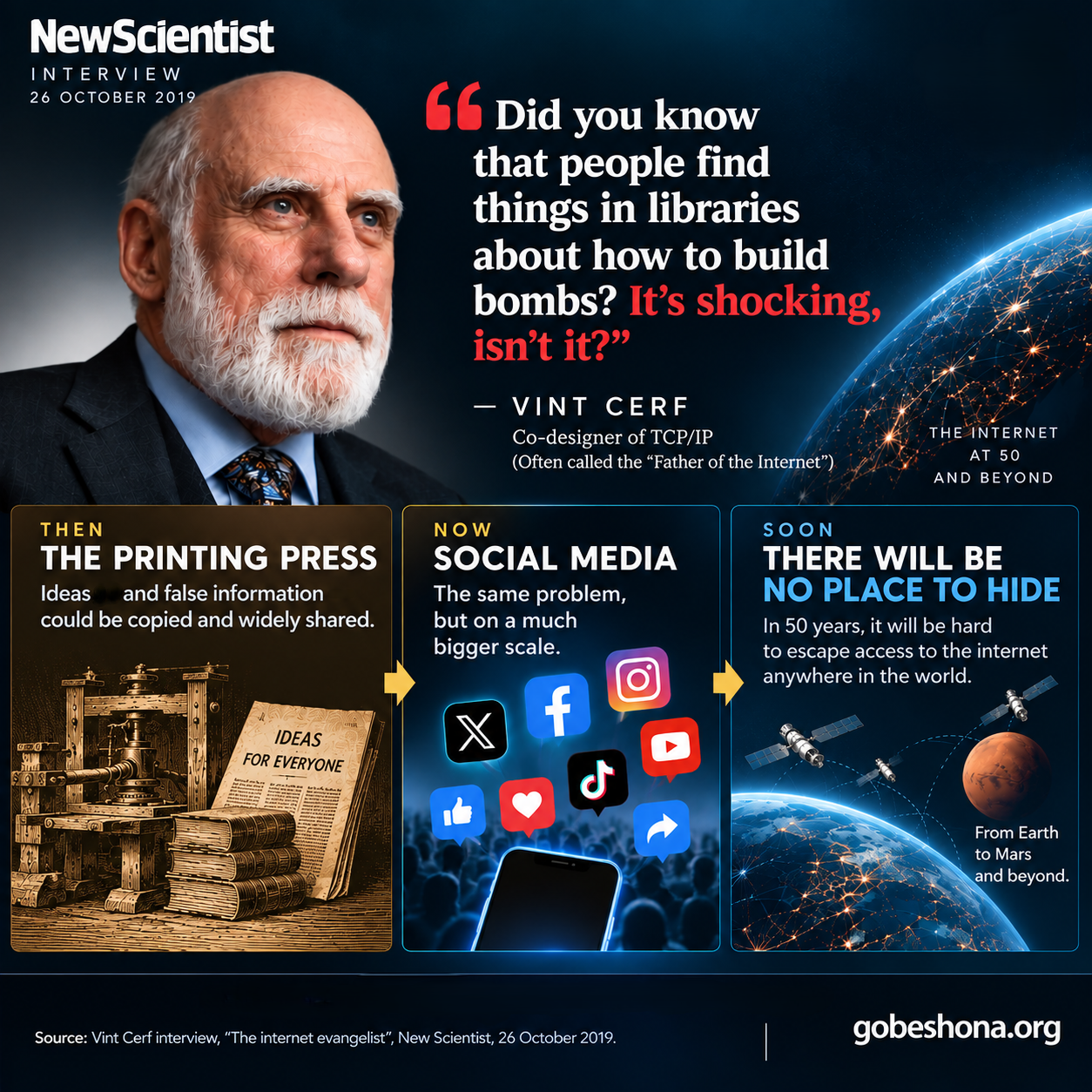
This is the section that became the main quotation on our image.
The interviewer asks whether Cerf’s optimistic view underplays the internet’s dangers.
Cerf responds provocatively by pointing out that people can find information in libraries about how to build bombs.
His point isn’t really about libraries or bombs.
He’s challenging the assumption that dangerous information became a problem only because of the internet.
Libraries already provided access to enormous quantities of information—some of which could potentially be misused.
The internet radically expands access, but the underlying tension between open access to information and harmful information predates it.
Cerf nevertheless remains strongly in favour of information access.
He argues that internet access makes information much more readily available and considers that access extremely valuable.
But he acknowledges a serious problem:
Misinformation and disinformation
Society must work out how to handle misinformation and disinformation without creating an authoritarian internet in which people are no longer free to express themselves.
That balance is central to this part of the interview:
Open information ←→ harmful or misleading information
Cerf doesn’t propose solving the second problem by simply eliminating the first.
6. Should companies such as Google regulate the internet more?
The interviewer then asks whether internet companies should intervene more aggressively.
Cerf’s answer emphasizes that internet companies operate across many different financial and legal jurisdictions.
That makes regulation considerably more complicated than simply saying:
“Google should remove bad information.”
Countries have different:
- laws;
- standards;
- political systems;
- definitions of harmful material;
- approaches to freedom of expression.
Cerf therefore treats internet governance as an international problem rather than something a single company can easily solve.
7. Should governments control what people can and cannot do online?
Cerf acknowledges that some information can clearly be harmful.
He notes that some governments dislike citizens using the internet to obtain information, share information or coordinate activities.
He also refers to the role of mobile technology and social media during the Arab Spring in 2011.
This raises a fundamental political and technological dilemma.
The same infrastructure that allows:
- education,
- communication,
- political organisation,
- information sharing,
can also be used for:
- misinformation,
- manipulation,
- harmful activities.
So the technology itself doesn’t automatically determine whether the outcome will be beneficial or harmful.
8. What is Cerf’s proposed answer to misinformation?
This is perhaps the most important section for understanding our LinkedIn post.
Cerf’s answer is:
Education.
He argues that people need to develop the ability to think critically about information.
People should be able to:
- analyse information;
- question what they encounter;
- identify poor-quality information;
- distinguish credible material from misleading material.
In other words, the solution cannot depend entirely on platforms filtering everything before users see it.
Users themselves need stronger information-literacy skills.
Cerf also makes another distinction.
There is a difference between someone accidentally sharing incorrect information and someone deliberately misleading other people.
He suggests there should be consequences for deliberate deception.
This makes his approach roughly two-sided:
Education for the information consumer + accountability for deliberate deception.
9. Why our printing-press → social-media illustration fits the discussion
This point needs one important distinction.
The printing-press → social-media progression on our image is an explanatory historical analogy, not a quotation from these two New Scientist pages.
But it helps illustrate the problem Cerf discusses.
Before mass printing, reproducing information was comparatively difficult.
The printing press radically reduced that barrier:
one document → many copies → many readers
That transformation enormously benefited education, science and public communication.
But technological systems don’t reproduce only true information.
They reproduce information.
So false claims could also travel further.
Social media represents another dramatic reduction in the cost and difficulty of publishing:
Printing press
One publisher → many physical copies
↓
Internet
Anyone connected → potentially global publication
↓
Social media
Anyone with a smartphone → instant publication + sharing + algorithmic distribution
That is the idea behind our image:
Misinformation isn’t new. The scale, speed and reach have changed.
The analogy helps explain Cerf’s concern without claiming that he used those exact words in this particular interview.
10. Cerf thinks connectivity itself remains a huge global problem
The interview then moves away from misinformation and toward internet access.
The interviewer asks Cerf about the importance of access.
Cerf points out that, at the time of the interview, only roughly half of the world’s population was online.
And much of the unconnected population lived in rural areas.
This creates a major infrastructure problem.
Traditional terrestrial infrastructure isn’t always economically or geographically practical for remote populations.
Cerf therefore discusses several possible technologies for expanding connectivity, including:
- large-scale satellite networks;
- submarine/undersea cables connecting continents;
- other infrastructure capable of reaching isolated populations.
This is an important counterbalance to the earlier discussion.
Cerf worries about misinformation while simultaneously wanting substantially more people connected to the internet.
His position therefore isn’t:
“The internet creates problems, so reduce access.”
It is closer to:
“Expand access while learning how to manage the problems that expanded access creates.”
11. What excites Cerf most about today’s internet?
Cerf identifies several developments.
One is the rapid increase in access to networks.
Another is the increasing availability of:
- Wi-Fi;
- 4G;
- eventually 5G.
But perhaps the bigger transformation is the enormous number of devices connecting to the internet.
This is what we now commonly call the:
Internet of Things (IoT)
Instead of only computers and phones connecting to the internet, many everyday objects can become networked.
That creates convenience.
But Cerf immediately identifies the other side:
Security risk.
As society becomes increasingly dependent on connected devices, poorly secured devices can create serious vulnerabilities.
He specifically refers to devices such as webcams.
If manufacturers don’t provide mechanisms for updating software—or stop supporting devices while they remain in use—the devices can become security liabilities.
12. Connectivity can make society more fragile
This is another particularly interesting part of the interview.
More connectivity does not automatically mean greater resilience.
The opposite can happen.
If important systems increasingly depend upon internet-connected devices, vulnerabilities in those devices can create wider consequences.
Cerf therefore worries about what happens when:
more devices + more dependence + inadequate security
come together.
A connected society can become extraordinarily efficient.
But failures can potentially propagate through systems that were previously independent.
That is why cybersecurity becomes increasingly important as connectivity expands.
13. Cerf is less worried about bandwidth than cybersecurity
The interviewer asks whether Cerf has fully considered problems involving:
- security;
- bandwidth;
- energy implications of the Internet of Things.
Cerf says he is comparatively less concerned about bandwidth.
He expects networking capacity to continue improving.
He is also relatively optimistic that technological improvements can address some energy issues.
What concerns him considerably more is the security vulnerability created by connected devices.
Particularly troubling are devices whose manufacturers don’t provide software updates.
Imagine a connected device remaining physically functional for many years while its software becomes obsolete and vulnerable.
The hardware still works.
The security surrounding it doesn’t.
That could create serious systemic risk as society becomes increasingly dependent upon connected infrastructure.
14. What will the internet look like 50 years later?
Now the interview becomes particularly futuristic.
Cerf predicts that the internet will continue expanding until connectivity becomes extremely widespread.
This produces the line behind the third panel of our image:
“It will be hard to escape access to the internet anywhere in the world.”
Importantly, he isn’t literally saying that people will have “no place to hide.”
Our image uses NO PLACE TO HIDE as a visual interpretation of his prediction.
His actual idea is that internet connectivity may eventually become available almost everywhere.
Cerf expects satellite constellations to play an important role.
Instead of connectivity being dependent entirely upon terrestrial infrastructure, networks of satellites could provide access across enormous geographical areas.
That potentially changes connectivity for:
- remote communities;
- ships;
- isolated regions;
- developing infrastructure;
- eventually extraterrestrial environments.
15. The internet may eventually extend beyond Earth
Cerf then goes considerably further.
He discusses the idea of an:
Interplanetary Internet
Internet protocols already had applications connected with space exploration.
But conventional internet networking faces a major problem once communication distances become astronomical.
On Earth, network delays are usually small enough for familiar networking techniques.
Between planets, signals can take minutes—or much longer—to travel.
A conventional Earth-based protocol therefore isn’t necessarily suitable.
Cerf discusses work on a different networking approach designed to handle those enormous delays and disruptions.
The interview mentions the Bundle Protocol, developed for interplanetary communication.
The broader vision is extraordinary:
Earth → Mars → other planets
Instead of thinking of the internet merely as a planetary communications system, Cerf imagines networking eventually becoming an infrastructure for human and robotic activity across the solar system.
This is why our graphic ends with:
From Earth to Mars and beyond.
16. Will Cerf’s original internet still exist?
The interviewer asks whether the internet Cerf originally helped design will still exist in that distant future.
Cerf explains that ordinary TCP/IP wasn’t designed for communication across planetary distances.
That is why alternative networking protocols are required for interplanetary communication.
So even Cerf doesn’t expect the internet to remain technologically frozen.
This connects beautifully with something he said at the beginning of the interview.
Remember the original design philosophy?
Make the system flexible enough to accommodate technologies that don’t yet exist.
Nearly half a century later, the same principle remains relevant.
17. What does Cerf regret?
Near the end, Cerf is asked about his pride and regrets after roughly 50 years.
His regret concerns malicious human behaviour.
Technology itself doesn’t eliminate the human capacity to misuse it.
He essentially says that human nature hasn’t fundamentally changed.
That observation connects many parts of the interview:
Internet openness
↓
creates enormous opportunities
but
Human behaviour
↓
can produce misinformation, malicious activity and security problems.
The internet magnifies both.
18. What is Cerf proud of?
Cerf expresses pride in what he and others managed to accomplish.
But his final aspiration isn’t primarily technological.
He says he would like to be remembered as someone who worked very hard to develop a better world.
That is a fitting conclusion because the interview isn’t ultimately just about networking protocols.
It is about what people choose to do with connectivity.
Leave a Reply