
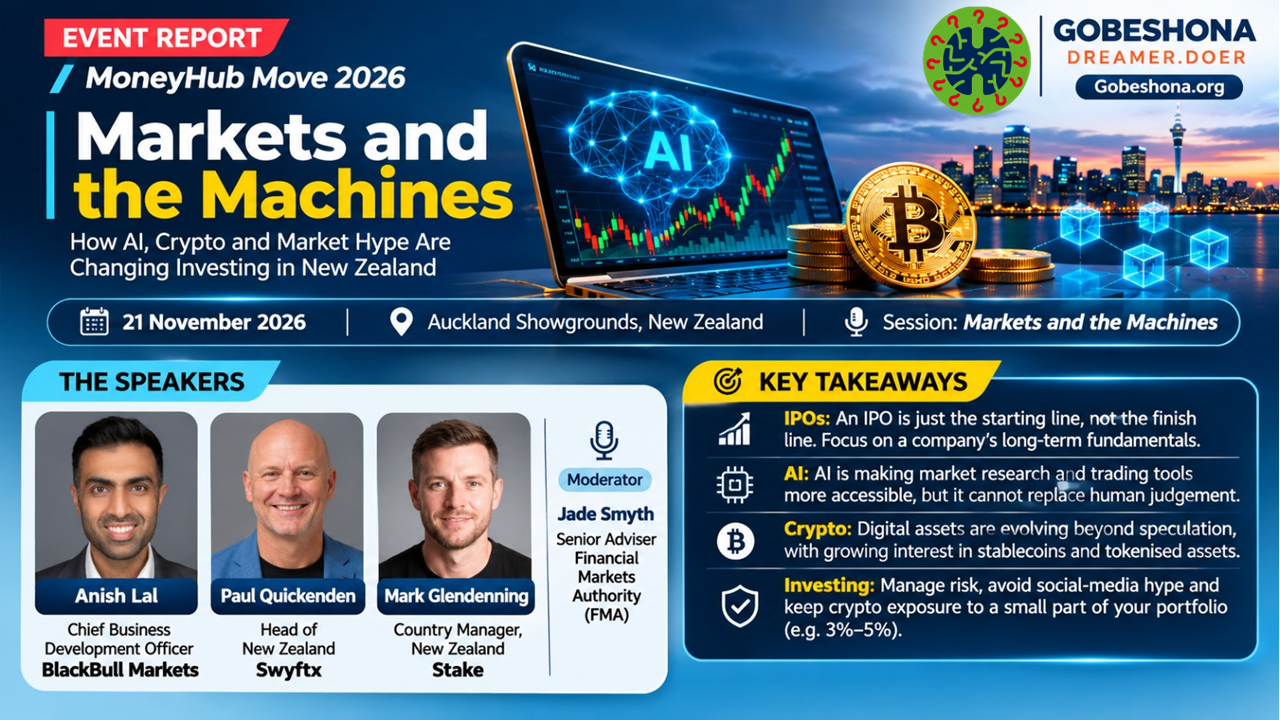
MoneyHub Move 2026 brought together investment and financial technology professionals to discuss artificial intelligence, cryptocurrency, IPO volatility and the importance of informed financial decisions.
AUCKLAND, 21 November 2026 | Gobeshona Event Report
Artificial intelligence is transforming the way investors analyse financial markets, while cryptocurrency and blockchain technology are creating new opportunities for digital investment. Yet, despite these developments, the responsibility for making informed financial decisions remains firmly with investors themselves.
This was a central message from the “Markets and the Machines” panel at MoneyHub Move 2026, held at Auckland Showgrounds on Saturday, 21 November.
The approximately 20-minute session brought together professionals representing online share investing, financial trading and cryptocurrency. The discussion examined whether automated technologies can outperform individual investors, how digital assets are evolving and why market fundamentals remain important in an increasingly technology-driven financial environment.
The panel also addressed the dangers of social-media investment advice, the limitations of AI-generated recommendations and common mistakes made by inexperienced investors.
About the Speakers
The discussion featured three financial-industry professionals and was moderated by a representative of New Zealand’s Financial Markets Authority.
Mark Glendenning — Country Manager, New Zealand, Stake
Glendenning represents Stake, an online share-investing platform offering access to US equities and exchange-traded funds. He discussed IPO market behaviour, share-price volatility and the importance of examining a company’s underlying business before making investment decisions.
Anish Lal — Chief Business Development Officer, BlackBull Markets
Lal is a financial markets professional working with BlackBull Markets, a New Zealand-based trading services provider. His contribution focused on AI-powered investment tools, automated trading strategies, market information and the importance of human oversight.
Paul Quickenden — Head of New Zealand, Swyftx
Quickenden represents cryptocurrency trading platform Swyftx. He discussed cryptocurrency adoption in New Zealand, stablecoins, tokenised assets, blockchain infrastructure and risk management for digital-asset investors.
Jade Smyth — Senior Adviser, Financial Markets Authority (FMA)
Smyth moderated the session, guiding the discussion through questions about IPO investing, artificial intelligence, cryptocurrency and the challenges facing everyday investors.
IPO Investing: Why Market Excitement Can Be Misleading
The panel began by examining the volatility that frequently accompanies initial public offerings (IPOs).
When a company first lists on a stock exchange, investor enthusiasm can generate substantial trading activity and sharp price movements. However, the initial excitement does not necessarily reflect the company’s long-term financial prospects.
Mark Glendenning discussed how newly listed shares may rise significantly during their first trading session before some of those gains disappear.
One example raised during the discussion involved a share price initially increasing by approximately 34%, before its gain narrowed to around 17%.
The example demonstrated how quickly market sentiment can change during the early stages of public trading.
Glendenning emphasised that investors should assess a company’s underlying fundamentals, including product quality, customer demand, revenue growth and its ability to generate sustainable profits.
Rather than rushing to purchase shares immediately after listing, investors can take time to evaluate the company’s financial performance and business model.
His central argument was that the first trading day should not determine an investor’s entire assessment of a business.
A fundamentally strong company may remain an attractive investment opportunity several months after its initial listing.
Artificial Intelligence Is Democratising Financial Market Analysis
The discussion subsequently turned to artificial intelligence and its growing influence on financial-market participation.
Anish Lal explained how AI-powered applications are helping investors analyse substantial volumes of information, interpret financial news, develop trading strategies and test investment approaches using historical data.
Previously, sophisticated financial research systems were primarily available to professional investment institutions.
Lal referred to the high cost of professional financial-information services, including Bloomberg terminals, to illustrate the traditional barriers faced by individual investors.
However, technological developments are changing this environment.
Retail investors can now use AI-based applications to construct investment dashboards, examine international markets and process financial information more efficiently.
For investors based in New Zealand, these tools can make it easier to research companies and investment opportunities across different countries and asset classes.
Lal also referred to surveys indicating widespread adoption and high satisfaction with AI tools among investors and traders. However, the specific research sources were not identified during the recorded discussion, so these figures require independent verification.
The broader implication was that access to investment information is becoming more democratic.
Nevertheless, access to sophisticated technology does not automatically guarantee successful investment outcomes.
Investors still need to understand the information generated by these systems and evaluate its relevance to their financial objectives.
Can Artificial Intelligence Replace Financial Advisers?
One of the session’s most important discussions concerned the limitations of AI in investment decision-making.
Although artificial intelligence can identify historical patterns, process market data and generate investment suggestions, Lal argued that it cannot fully replicate the personal judgement and emotional understanding involved in financial advice.
For example, an investor experiencing a 30% decline in portfolio value may need guidance that considers personal financial circumstances, risk tolerance and long-term objectives.
These factors cannot always be captured through automated data analysis.
Lal also highlighted the limitations of historical financial models during unexpected economic developments.
Relationships between equities, commodities, cryptocurrencies and other asset classes can change during periods of market stress.
An AI system relying heavily on historical information may therefore generate recommendations that fail to reflect current market conditions.
The panel also discussed the problem of AI hallucinations, in which artificial intelligence produces inaccurate or misleading outputs.
This is particularly important in financial markets, where incorrect information may influence decisions involving real money.
Lal emphasised that investors should maintain independent judgement rather than rely exclusively on automated buy-or-sell recommendations.
The discussion also touched on the importance of compliance, data governance and appropriate safeguards when financial institutions introduce AI-powered systems.
The key message was that AI should support investment research and decision-making, rather than replace investor responsibility.
Cryptocurrency Adoption and the Future of Digital Assets in New Zealand
Paul Quickenden then examined the development of New Zealand’s cryptocurrency market and its potential evolution over the next decade.
He discussed research suggesting that cryptocurrency participation may be more widespread than some conventional market indicators show.
An estimate of approximately 750,000 cryptocurrency participants in New Zealand was mentioned during the discussion, although the recording did not establish the underlying research methodology sufficiently to independently verify the figure.
Quickenden explained that the digital-asset market is evolving beyond conventional cryptocurrency trading.
While Bitcoin remains an important component of the industry, new technologies are expanding the potential applications of blockchain-based financial systems.
Two developments received particular attention: stablecoins and asset tokenisation.
Stablecoins and Digital Payments
Stablecoins are digital assets generally designed to maintain a relatively stable value against another asset, commonly a national currency.
Quickenden discussed their growing relevance to the digital-asset ecosystem, particularly as technologies that can facilitate the movement of money.
Unlike highly volatile cryptocurrencies, stablecoins aim to provide greater price stability, although their reliability depends on their design, reserves and governance.
Their potential applications include digital payments, cross-border transfers and settlement between financial platforms.
The discussion suggested that digital assets are increasingly becoming part of a broader conversation about financial infrastructure rather than remaining exclusively speculative investment products.
Tokenisation: Expanding Access to Financial Assets
Tokenisation was another significant theme.
The technology involves representing ownership rights or financial claims through digital tokens, often using blockchain infrastructure.
Quickenden referred to the tokenisation of US government bonds as an example of traditional financial instruments entering digital-asset markets.
He also discussed potential applications involving bank deposits, property and gold.
Tokenisation may enable certain assets to be divided into smaller investment units, potentially reducing barriers to participation.
For example, fractional ownership arrangements could make some investments accessible to individuals who cannot afford to purchase an entire underlying asset.
However, tokenisation does not automatically eliminate investment risk.
Investors must still consider ownership rights, liquidity, custody, regulation and the financial characteristics of the underlying asset.
The discussion nevertheless highlighted tokenisation as an area of potential development within global financial markets.
Will Traditional Financial Markets Become More Like Cryptocurrency Markets?
Looking towards the next decade, Quickenden suggested that digital assets could become a more established component of diversified investment portfolios.
He also anticipated that conventional financial markets would increasingly adopt technologies associated with digital assets.
One important difference between cryptocurrency markets and traditional stock exchanges is trading availability.
Cryptocurrency markets operate continuously, while conventional equity markets generally follow scheduled trading hours.
Quickenden suggested that the growth of continuous digital-asset trading could influence future developments in traditional market infrastructure.
He also referred to blockchain-related developments involving the Australian Securities Exchange.
Although the discussion did not provide sufficient detail to verify a specific initiative, the broader point concerned the possible convergence of conventional financial systems and blockchain-based technologies.
Such developments could affect how securities are issued, traded, settled and held.
The potential implications extend beyond cryptocurrency investing to banking, capital markets and financial-market infrastructure.
Cryptocurrency Risks: Investors Must Understand What They Own
Despite discussing the opportunities associated with digital assets, Quickenden also emphasised the importance of understanding cryptocurrency investment risks.
He warned against relying on social-media commentary as the primary basis for investment decisions.
Digital-asset markets can experience substantial price fluctuations, partly because trading continues around the clock and responds rapidly to international developments.
Quickenden encouraged investors to conduct independent research, understand the assets they purchase and establish realistic investment time horizons.
He also discussed the importance of limiting exposure to highly volatile assets within a broader portfolio.
An allocation range of approximately 3%–5% was mentioned as an example drawn from investment research, rather than as a recommendation suitable for every investor.
The discussion reinforced the principle that investment decisions should reflect individual financial circumstances and tolerance for losses.
Cryptocurrency may offer significant opportunities, but it can also generate substantial losses.
The Biggest Mistakes Made by New Investors
During the final part of the session, the speakers discussed common mistakes made by individuals entering financial markets.
Several themes emerged.
Following social-media investment advice: Investors may place excessive confidence in influential commentators without independently evaluating the underlying assets.
Concentrating investments: Investing too much money in a single company or asset can expose individuals to substantial losses if market conditions change.
Ignoring risk management: Investors should understand how much money they could lose and establish appropriate investment limits.
Waiting indefinitely to invest: Excessive analysis can also prevent individuals from beginning their investment journey, even when they have suitable long-term financial objectives.
Overreliance on technology: AI-generated information can assist investors, but automated recommendations should not replace independent research and judgement.
The panel also discussed diversification and regular investment strategies, including dollar-cost averaging, as approaches investors may consider when managing uncertainty.
Rather than attempting to predict every short-term market movement, the speakers emphasised the value of financial knowledge, discipline and a consistent investment approach.
What This Means for New Zealand Investors
The session highlighted three developments that may influence the future of investing in New Zealand.
First, artificial intelligence is reducing information barriers and making sophisticated analytical capabilities more accessible to everyday investors.
Second, cryptocurrency and blockchain technology are expanding beyond speculative trading into areas such as digital payments, tokenisation and financial infrastructure.
Third, investor behaviour remains a major factor in financial outcomes.
Even with advanced trading platforms and AI-powered research tools, individuals remain vulnerable to market hype, emotional decisions and inadequate risk management.
These developments suggest that financial literacy will remain essential as financial technology becomes more sophisticated.
For New Zealand’s investment industry, the challenge is not simply to provide access to innovative products, but also to help investors understand their opportunities and risks.
Conclusion: Technology Is Changing Investing, but Human Judgement Still Matters
The “Markets and the Machines” session at MoneyHub Move 2026 offered a timely examination of how technology is reshaping financial markets.
From IPO volatility and AI-assisted research to cryptocurrency adoption and tokenised financial assets, the discussion demonstrated the expanding range of opportunities available to individual investors.
However, the speakers consistently emphasised that greater technological sophistication does not eliminate financial risk.
Investors must still understand business fundamentals, assess market information critically, manage their exposure and make decisions consistent with their financial circumstances.
For everyday investors, the message was clear: financial technology can provide better tools and broader access, but responsible investment decisions continue to depend on knowledge, research and human judgement.
Event: MoneyHub Move 2026
Session: Markets and the Machines
Date: 21 November 2026
Venue: Auckland Showgrounds, New Zealand
Published by: Gobeshona
Reporting basis: Firsthand attendance
Source: MoneyHub Move 2026 — Official Event Programme
Editorial disclosure: This report is based on attendance at the event. Speaker positions and event details were checked against the official programme. Some numerical statements in the recording could not be independently verified and are identified accordingly. This article is event reporting and does not constitute personalised financial advice.
Leave a Reply